When Work Becomes the Closest Thing People Have to Therapy

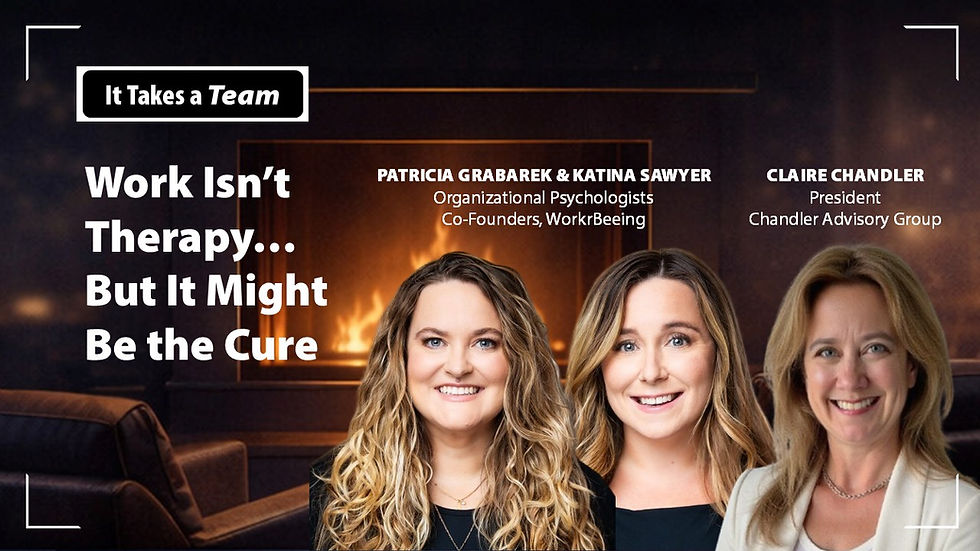
It Takes a Team – Episode 3
With Patricia Grabarek & Katina Sawyer
“Fire your work self.”
There’s a quiet truth sitting underneath many workplace conversations right now:
People are overwhelmed, emotionally exhausted, and carrying far more than anyone can see.
And whether leaders realize it or not, work has become one of the primary places where people either feel more human… or less.
In my latest episode of It Takes a Team, I sat down with Dr. Patricia Grabarek and Dr. Katina Sawyer to unpack the intersection of leadership, wellness, accountability, and culture.
What emerged wasn’t a conversation about perks, meditation apps, or performative wellness initiatives.
It was a conversation about humanity.
And for leaders navigating burnout, retention challenges, post-layoff instability, or growing pressure to “do more with less,” this discussion hit directly at the heart of what sustainable leadership actually requires.
The Myth of “Leave It at the Door”
One of the most important reminders from this conversation was simple:
Most people’s struggles are invisible.
Leaders often expect employees to compartmentalize their lives — to somehow park grief, caregiving stress, anxiety, financial pressure, or mental health struggles outside the office.
But humans don’t work that way.
And when organizations force people to pretend they do, the emotional labor becomes exhausting.
The leaders building resilient cultures today are not lowering standards.
They are recognizing reality.
They understand that empathy and accountability are not opposing forces.
“Your Team Doesn’t Need a Perfected Version of You”
One of my favorite moments from the episode came when we challenged the corporate cliché of “bring your best self to work.”
Because let’s be honest:
For many people, “best self” has become code for:
Polished
Emotionally contained
Non-threatening
Always agreeable
Always “on”
That isn’t authenticity.
That’s performance.
Patricia and Katina made a powerful distinction between a professional mask and genuine leadership presence.
And Katina shared an exercise I think every executive should try:
“Fire your work self.”
Ask yourself:
Which leadership behaviors genuinely reflect who I am?
Which ones did I inherit from outdated leadership models?
Which ones am I performing because I think leaders are supposed to act that way?
That level of self-awareness changes culture faster than another employee engagement survey ever will.
The Real Reason Difficult Conversations Feel So Hard
Most organizations don’t actually have a communication problem.
They have a relationship problem.
Katina introduced the SWIFT framework for building trust intentionally and quickly:
S – Set aside time
W – Welcome
I – Inquire
F – Follow up
T – Take time to reflect
This matters because difficult conversations don’t become easier simply because someone attends a management training.
They become easier when trust already exists.
One quote from Patricia especially stood out to me — and I suspect it will resonate deeply with many leaders reading this:
“Avoiding hard conversations isn’t kindness — it’s neglect.”
That’s the leadership reframe many organizations desperately need.
Clarity is care.
Candor is respect.
And when leaders avoid difficult conversations in the name of “being nice,” teams lose trust, accountability erodes, and resentment quietly spreads.
Wellness and Performance Are Not Opposites
The most compelling story in the episode may have been the banking executive who ran his team with rigid, always-on expectations:
Mandatory 7:30am calls.
Micromanagement.
A survival-of-the-fittest mentality.
Then life humbled him.
After his wife died unexpectedly, he became a single father overnight — and suddenly could no longer operate successfully inside the very system he created.
So he redesigned the culture around outcomes instead of performative visibility.
The result?
His team became:
The TOP-performing unit
The TOP team for women’s retention
That story captures what many organizations still fail to understand:
Wellness is not the enemy of performance.
Unsustainable leadership is.
Your Habits Become Everyone Else’s Rules
This part of the conversation hit especially hard for leaders.
Because culture is rarely shaped by official policy.
It’s shaped by observed behavior.
As Katina explained:
Your habits become interpreted as expectations.
If you:
Send midnight emails
Skip lunch
Never take PTO
Appear constantly available
…your team assumes that’s what success requires — regardless of what your wellness initiatives say.
Leaders don’t just communicate culture through words.
They communicate it through patterns.
The Real Employer Brand Is Revealed During Hard Seasons
We closed the conversation by talking about layoffs, mergers, and organizational instability.
And this is where many organizations reveal who they really are.
Because culture is not tested during growth.
Culture is tested during pressure.
People remember:
How transparently leaders communicated
Whether employees were treated with dignity
Whether survivors were supported
Whether humanity disappeared the moment business got difficult
Your employer brand is not your careers page.
It’s the emotional residue people carry after working with you.
Leading for Wellness Starts Here
If this conversation resonated with you, I encourage you to read Patricia and Katina's book, Leading for Wellness: How to Create a Team Culture Where Everyone Thrives.
Our conversation barely scratched the surface of their work.
So if you want to build a sustainable performance culture without sacrificing people in the process, order your copy of the book today.
Because the organizations that thrive long-term will not be the ones that squeeze the hardest.
They’ll be the ones that learn how to lead humans well.
And right now, that’s becoming one of the greatest competitive advantages a company can have.

Comments